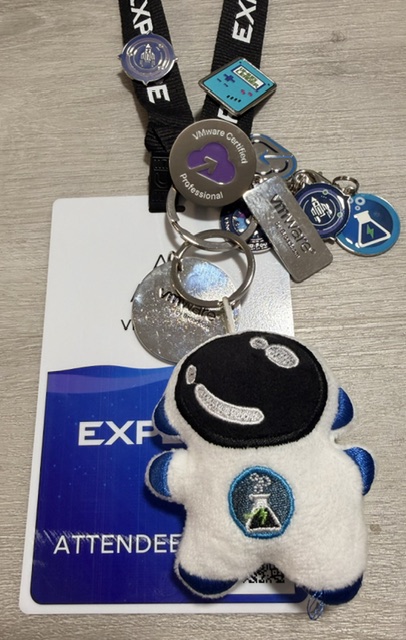
Seven years of Explore under my belt (VMworld, if you’re old enough to remember the lanyards), and this is the first one where I came home with more notes than swag. That’s either a sign the conference matured or a sign I finally stopped wandering the expo floor for free socks. Probably both.
Here’s my honest recap of Explore 2026 at the Venetian, in roughly the order it lives in my head.
The Community is still the engine
Say what you want about attendance numbers, the vCommunity didn’t get the memo that things were supposed to feel smaller. VMUG was everywhere. The community sessions (the ones with the CMTY prefix, if you’re scanning the catalog) were some of the most candid sessions of the week, because the people presenting them don’t have a product roadmap to protect. They just run the stuff.
I sat in on Brad Tompkins’ “Real Talk” session on what VMUG members are actually seeing out there, and it was refreshingly unvarnished. Add the Odyssey tournament finals in the HOL room, and the usual hallway track that runs on caffeine and grievances, and you’ve got the reason I keep coming back. Broadcom can move the venue. It can’t move the people.
Which is exactly why the next part stings.
Thank you, Corey Romero
Days after the show wrapped, Corey Romero posted that Broadcom had let him go. If you don’t know the name, you know his work. Corey ran the vExpert program since 2014 and spent close to two decades in the VMware community before that title ever existed. When he took it over there were around 500 vExperts. He grew it past 1,300, spun up eleven sub-programs, built the first VMware WordPress instance and kept quietly maintaining it long after his job title stopped saying “engineer,” and handled the applications, the directory, the Slack, the briefings, and the Explore meetups mostly by himself.
The part I want to say plainly: when the acquisition closed, most of us assumed vExpert was done. Corey is the reason it wasn’t. He fought to keep the program funded, adapted it to a company that had no obligation to care about a community recognition program, negotiated the partner perks so people still had a reason to apply, and kept the lights on for two more years while the rest of the ecosystem was busy writing VMware’s obituary. The vExpert badge on a lot of LinkedIn profiles this year, including mine, exists because one person decided it was worth the fight.
The timing is what it is. The same week Broadcom told the world it had “corrected” its approach to smaller customers, it walked out the person who held the small-customer community together. I’ll leave the editorializing there.
Corey, thank you. For the years of answering emails at hours no community manager should be awake, for making a global program feel like a group text, and for treating a bunch of bloggers and homelab nerds like they mattered. You didn’t just keep vExpert alive. You kept it together.
If you’re hiring for anyone who knows how to build and hold a technical community, his post is here: https://lnkd.in/p/gFS_5aAA. Go read it, then go write him a recommendation. He wrote plenty for us.
VCF is not just vSphere with extra steps
I’ll admit it: I’m a vSphere person. I’ve spent a good chunk of my career living in the vSphere Client, and every time someone said “VCF” I mentally translated it to “vSphere with a bigger invoice.” This year, between the Hands-on Labs and the Odyssey Labs, I finally got enough time on the 9.1 stack to change my mind.
What clicked for me is that VCF 9 isn’t a bundle of products anymore. It’s one operating model:
- Fleet management is where SDDC Manager’s job went to grow up. You manage multiple VCF instances (the “fleet”) from VCF Operations, and lifecycle is tracked at the fleet level rather than per-cluster-per-product-per-ticket.
- VCF Operations is the single pane of glass we’ve been promised since roughly 2012 (How many times did the name change? vRealize, Aria), except this time it’s real. Inventory, health, capacity, cost, diagnostics, lifecycle, all in one place. The “From Firefighting to Foresight” and “Full-Stack Troubleshooting” sessions are worth your time if you’re skeptical, because I was.
- VCF Automation (VCFA) is where the self-service and IaC story lives. VPCs, catalogs, app stacks captured from live VMs, and a much more tenant-aware model than Aria Automation ever had.
- Certificate management is finally boring, which is the highest compliment I can give it. Certs across the fleet are handled centrally in VCF Operations. If you’ve ever spent a Saturday chasing an expired cert across NSX, vCenter, and a management appliance nobody remembers deploying, you understand why this matters.
And the timing was good: VCF 9.1.1 went GA. William Lam has a great rundown of what’s in it (https://williamlam.com/2026/09/10-exciting-enhancements-in-vmware-cloud-foundation-9-1-1.html), but the highlights I care about are back-in-time upgrade support (so those 5.2.4 and 8.0 U3 environments finally have a direct path to 9.1), a smaller footprint for VCF Management Services with a new Small HA option, a --latest flag in the VCF Download Tool so you stop guessing which Express Patch is current, and single-host and non-HCL disk support baked right into the installer UI for lab and PoC work. That last one is a big deal for anyone building a homelab. VLAN-backed VPCs without a TEP network are also now a thing, which lowers the barrier to actually trying VPCs.
The honest caveat: if you’re still on vSphere 7 or 8 with no NSX and no vSAN, the jump to VCF is a real project, not a Tuesday. The “Choosing the Right Path to VCF 9: Upgrade, Converge, Import, or Rebuild” session is the one to watch before you scope anything.
Memory tiering: go research this today
If you take one technical thing away from this post, make it this one. There were at least five sessions on memory tiering this year, and the titles tell you the mood: “Avoiding the RAM-pocalypse,” “The Next Deduplication,” “The VCF 9 Feature Your Budget Needs Right Now.” Subtle, they were not.
Here’s the short version. ESX now treats a dedicated NVMe device as a second memory tier. DRAM is Tier 0, NVMe is Tier 1, and the hypervisor tracks which pages are hot and which are cold and moves them accordingly. Your VMs see one logical memory pool. No guest OS changes, no application changes, and DRS and vMotion are aware of it.
Why it matters right now:
- Cost. DDR5 pricing has gone sideways in 2026, and the per-gigabyte gap between DRAM and enterprise NVMe is somewhere in the neighborhood of 40 to 1. Broadcom’s own numbers put it at up to 40% TCO savings on memory. An independent test I saw cited during the show had a memory-tiered config coming in about 35% cheaper on memory-related hardware than a full 1TB DRAM box while keeping roughly 85% of the throughput on a database workload. Your mileage will vary, but the direction is clear.
- Density. The default DRAM:NVMe ratio in VCF 9 is 1:1 (it was 4:1 in the 8.0 U3 tech preview). That’s double the logical memory per host out of the box, and the ratio is tunable. Broadcom’s guidance says up to 4x with the right workload profile. Practically, that’s 2x VM consolidation on hosts you already own.
- CPU efficiency. This is the one people miss. A lot of hosts are memory-bound with cores sitting idle. Give those cores more addressable memory and you pick up 20 to 30% better CPU utilization without buying a single socket.
- Operational ease. In 9.1 the whole setup lives in vSphere Configuration Profiles, so you configure it once for the cluster instead of host by host.
Sizing notes from the sessions: the NVMe device has to be dedicated (not shared with vSAN), it should be on the Broadcom Compatibility Guide, the max tier partition is 4TB, and you want to size the ratio based on your actual active memory, not your allocated memory. Pull your active memory numbers from VCF Operations before you go buy drives.
Between the hardware crunch and this feature, memory tiering is the closest thing to a free lunch I’ve seen in this stack in years. Go read the design and sizing series on the VCF blog and run the numbers for your environment.
The hardware crisis session, and the Dell-shaped hole in the room
I attended one of the “conquer the 2026 hardware crisis” sessions, and it lined up with what everyone in procurement already knows: DRAM and NVMe supply are tight, lead times are ugly, and “just buy more hosts” isn’t a strategy. The Broadcom answer is essentially: squeeze what you own. Memory tiering, the topology-aware CPU scheduler, vSAN ESA efficiency, and better rightsizing through VCF Operations.
Which brings me to the VxRail elephant.
There is now an official, Dell-and-Broadcom co-developed, in-place upgrade path from VCF on VxRail to VCF 9.1. In-place means no repave. That’s good news, with an asterisk: stretched clusters, 2-node, dynamic nodes, and satellite nodes have to wait for a later release.
So why now? Here’s my read. Dell ended its VMware distribution agreement back in March 2024, Michael Dell publicly called VxRail “less of a thing” last fall, and Dell has been steering customers toward Dell Private Cloud, which is a disaggregated PowerStore/PowerFlex model that’s also being built to run Nutanix AHV and OpenShift. That’s not a growth story for VxRail. But there are something like 20,000 VxRail customers and 300,000 nodes out there. A lot of those are older rails that were never going to see a hardware refresh in a year when a stick of RAM costs what it does. The 9.1 path is a bridge to keep that installed base supported and paying, not a signal that VxRail is back.
As for Dell not being on the show floor and not being name-dropped in the hardware sessions: I’ll be careful here because I don’t know, and neither does anyone I asked. Two theories floated in the hallways. One, it’s a sour relationship and Dell has decided its private cloud future runs through its own storage and a menu of hypervisors, so sponsoring a Broadcom show doesn’t make sense. Two, Dell is heads-down building something and didn’t want to share a stage with the vendor it’s differentiating against. Both can be true at once. What I’d tell a VxRail shop today: take the 9.1 upgrade path if you qualify, start your hardware planning as if the next box won’t say VxRail on it, and read the Dell Private Cloud fine print before you assume your existing nodes carry forward.
Smaller, quieter, and better
Attendance was reportedly around 4,700. That’s a fraction of the VMworld glory days, and yes, the expo hall had elbow room. The sessions, though, were the most technical I’ve seen in seven years. Four hundred-plus sessions, and the ones I picked were run by engineers who actually built the thing, not by someone reading a slide about “journeys.” I learned more in four days this year than in some full-size years.
The odd part: no traditional morning general session. There was an afternoon plenary on day one with announcements, customer stories, and the 2027 venue reveal, but not the big-stage kickoff we’re used to. The rumor mill says the Venetian was doing construction on our dates and the whole layout had to be shuffled to work around it. I can’t confirm that, but it would explain a few things about the room assignments. If you missed the plenary, the replay is in the Explore video library.
Every session with video on demand is catalogued here thanks William Lam, and it’s the single most useful link in this post: https://github.com/lamw/vmware-explore-2026-session-urls
Three exams, two passes, one big lesson
I sat for three exams this week and walked out with two passes. The third one and I will meet again.
The new VCF exams are not the exams you remember. Two things stood out:
VKS is everywhere. vSphere Kubernetes Service showed up in all three exams, repeatedly. Not as a bonus section, as core material. If you’re a VMware admin who has been treating Kubernetes as “the dev team’s problem,” that era is over. Supervisor, VKS clusters, VM Service, namespaces, VPC networking for VKS. Learn it. Federico Cinalli’s “VKS Networking Demystified: From vmnic to Pod” session is a great starting point.
The silos are gone. There used to be dedicated exams for NSX, vSAN, Operations, and Automation. That content now lives inside the VCF Administrator and Architect exams. You can’t specialize your way past the parts you don’t like anymore. I think that’s the right call. VCF is one platform, and the exams finally test it like one.
If you have a VCF entitlement, the learning portion with live instructors is not a checkbox to ignore. I used it to prep and the instructors were the reason I passed the two I passed. It’s already paid for. Use it. The community also ran a “VCF Certification 2026: Tips, Tricks, and Guidance” session that’s worth a watch before you book.
Cloud is a spreadsheet now, not a slogan
The tone around public cloud has shifted. It’s not “everything to the cloud” and it’s not “repatriate everything” either. It’s “show me the cost analysis.” Broadcom’s Private Cloud Outlook numbers were quoted a lot: 43% of organizations repatriating workloads are pulling AI training and inference back on-prem, and 62% of IT leaders are very concerned about AI infrastructure costs. The FinOps capabilities in VCF Operations got their own session, and “Dynamic ROI, FinOps, and Tokenomics” was a room full of people taking notes.
If your cloud initiative doesn’t have a cost model with real numbers behind it, you don’t have a cloud initiative. You have a vibe.
Explore 2027: new dates, new building
The big reveal at the plenary was that Explore is moving. May 3 to 6, 2027, at Resorts World Las Vegas. My guess on the why: Broadcom wants the show closer to a spring release cycle, and Resorts World is a smaller, newer venue that fits a 5,000-person practitioner event better than a hall built for 20,000.
Registration opens January 12, 2027, and the call for proposals opens November 3, 2026. If you pre-register before September 30 you get $100 off the full pass: https://go-vmware.broadcom.com/vmware-explore-2027-pre-registration
The network still grows
Smaller show, same result: I met a pile of new people this week, reconnected with folks I only see once a year, and had at least three conversations that will turn into real work. If you’re on the fence about going next year because “it’s not what it used to be,” you’re right, it isn’t. It’s more useful.
See you at Resorts World.

